
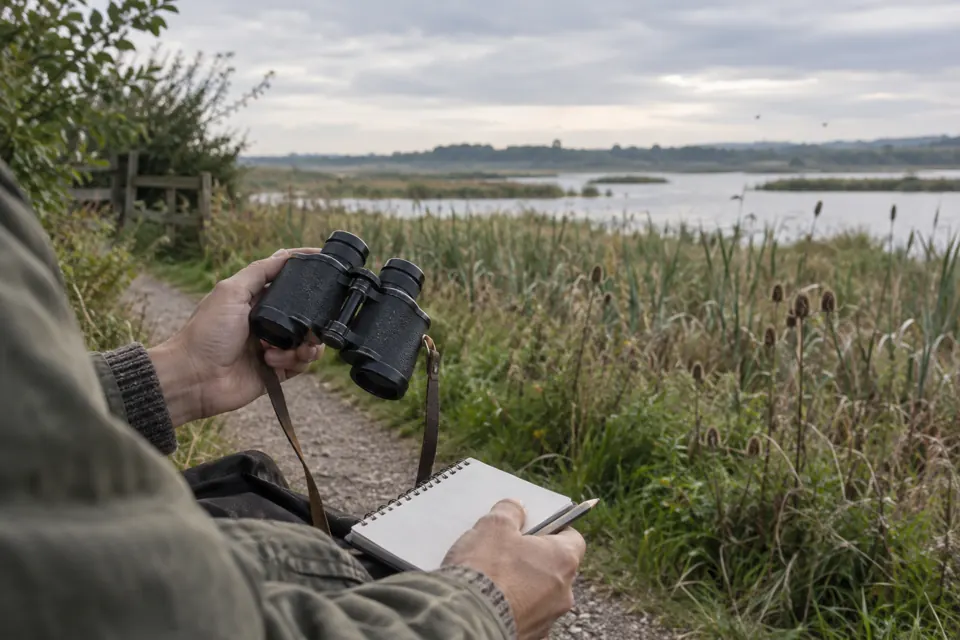
Binoculars and a notebook beside a reed-filled wetland path.

Sustineer lesson · Nature & Water

Notice biodiversity around your home

Make careful observations, understand their limits and contribute without disturbing the life you are trying to notice.

Purpose: Learn what observations can tell you, what they cannot and how to contribute responsibly.
18 minute read · 10 minute activity

Language and country are separate preferences. If a lesson is not translated, its English source text remains visible.

Reset

Explanation

Biodiversity is present in ordinary places: a verge, balcony, pond edge, park or allotment. Looking closely can build care, while a single observation remains one piece of evidence rather than a full inventory. Urban and suburban corridors act as vital ecological stepping stones, providing nourishment, water, and shelter for resident and migratory species.

Urban Microhabitats: Life in Small Niches

Gardens, balconies, and urban green spaces can provide critical habitats when managed with ecological awareness. Simple structural diversity—combining tall shrubs, native perennials, bare earth, and deadwood—creates a variety of microclimates that support diverse living organisms.

  • Standing deadwood and brush piles provide sheltering and overwintering sites for woodlice, solitary bees, and hedgehogs.
  • Native flower borders provide specific nectar and pollen chemistry required by specialist native solitary bees and hoverflies.
  • Shallow water sources with emergent pebbles allow pollinators and small birds to drink safely without risk of drowning.

A vibrant patch of native pollinator flowers with seed heads left standing for winter shelter
Leaving 'untidy' patches of hollow stems and seed heads provides crucial overwintering habitat.

An observation has boundaries

  • Record what you saw, when and under what conditions.
  • Use identification tools as suggestions and check difficult records with an expert source.
  • Do not disclose a sensitive nest, rare plant or private location simply to make a record look complete.
Urban Microhabitats & Supported Wildlife
Habitat FeatureBeneficiary SpeciesEcological FunctionSimple Action Step
Leaf Litter & Compost LayerGround beetles, earthworms, song thrushesForaging zone and moisture retentionLeave fallen autumn leaves beneath hedges
Hollow Plant StemsSolitary mason and leafcutter beesEgg laying and winter hibernationDelay pruning perennial stems until late spring
Shallow Water BasinHoneybees, hoverflies, bats, garden birdsHydration and bathingPlace a wide shallow bowl with climbing stones
Untidy Native Grass PatchSkipper butterflies, grasshoppersCaterpillar host plants and sheltering grassLeave a 1-metre perimeter unmown during summer
Observing wild plants and insects quietly along a neighborhood greenway
Ethical wildlife tracking emphasizes quiet observation without trampling sensitive habitats.

Citizen Science and Data Ethics

Recording biodiversity through community science platforms like iNaturalist and GBIF contributes valuable occurrence data to ecological research. However, sensitive records must be protected from poaching, disturbance, and habitat degradation.

Try this

Turn the idea into observation

A respectful ten-minute survey

  1. Choose a route you can revisit without entering restricted habitat.
  2. Note three living things and one feature of the place.
  3. Share only the location detail that is safe and necessary.

What to remember

The useful parts

  • Describe an observation without overstating what it proves.
  • Protect sensitive locations and organisms.
  • Use repeated observations to ask questions, not to claim a complete survey.
  • State the scope of a record honestly.
  • Use tools without overstating certainty.
  • Handle sensitive observation data responsibly.
Optional knowledge checkSee what stayed with you

Optional knowledge check

See what stayed with you

Choose one answer, read the explanation, or skip a question. Nothing here blocks the next step.

1What can one observation usually tell you?

Not answered.

2How should an identification suggestion be treated?

Not answered.

3Why might a precise location be unsafe to share?

Not answered.

Sources and further learning

Evidence, limits and external destinations

Essential interpretation notes remain visible; external resources are labelled before you leave Sustineer.

External map · Naturkartan / participating publishers

Naturkartan

Find trails, nature areas and outdoor facilities through an outdoor map and guide.

Original entry: English, Swedish · Free core access

What is not assumed

Coverage depends on participating publishers. Recheck access, route conditions and local restrictions. No account needed for the public information reviewed.

External directory · Parks.it / protected-area publishers

Parks.it

Find Italian parks, visitor information and nature itineraries.

Original entry: Italian · Free core access

What is not assumed

Check the individual park’s current rules and opening details; a directory is not a legal boundary authority. No account needed for the public information reviewed.

External citizen science · iNaturalist

iNaturalist

Get identification suggestions for wild organisms and share observations with a community.

Original entry: English, Italian, Swedish · Free core access

What is not assumed

Not every observation is expert-verified. Never use an identification alone to assess edibility or safety. An account is required to contribute observations.

One related lesson or guide

Grow your first food