
Try it like this
Composting transforms unavoidable household food trimmings and dry organic residues into a biologically active soil conditioner. When organic waste is trapped inside anaerobic landfills, it breaks down without oxygen to produce methane; in contrast, aerobic composting engages oxygen-breathing bacteria, fungi, and invertebrates to cycle carbon and plant nutrients back into stable humus.
Balancing Nitrogen Greens and Carbon Browns
At its core, composting depends on managing the ratio between moist, nitrogen-rich 'greens' and dry, carbon-dense 'browns'. Greens—such as vegetable peelings, apple cores, and coffee grounds—supply moisture and protein for rapid microbial population growth. Browns—such as torn cardboard, dry fallen leaves, and straw—provide the physical porous structure that allows air to circulate through the decomposing mass.
- Aim roughly for two to three parts by volume of dry browns for every one part of fresh kitchen greens.
- Tear unbleached cardboard boxes, egg cartons, and plain brown paper bags into small palm-sized pieces to prevent dense matted layers.
- Chop large vegetable rinds or fibrous brassica stalks into smaller fragments to accelerate biological surface decomposition.
- For a home bin, leave out cooked food, meat, dairy, oils, and pet waste unless your local guidance specifically accepts them.
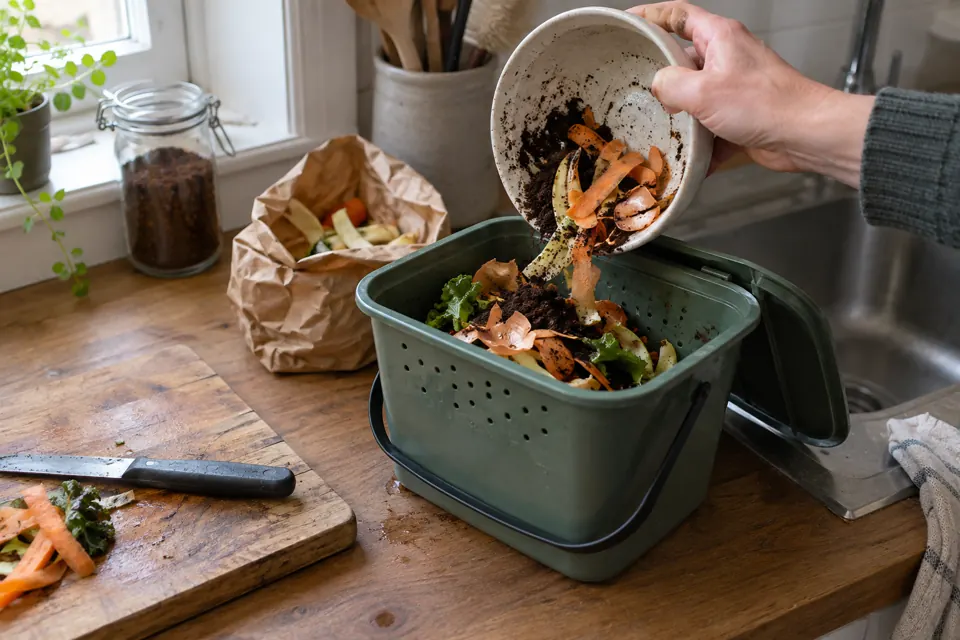
Managing Moisture, Airflow, and Small Spaces
An active compost heap or container should maintain the moisture level of a wrung-out kitchen sponge: noticeably damp to the touch, but yielding no free water when squeezed in a fist. If the contents become soggy and emit a sour odour, gently turn the material and incorporate generous handfuls of dry torn cardboard to absorb excess liquid and reintroduce oxygen.
| Material Type | Common Household Source | Function in the Pile | Preparation Note |
|---|---|---|---|
| Moist Greens (Nitrogen) | Raw vegetable scraps, tea leaves, coffee grounds | Fuels microbial heat and metabolism | Drain excess liquid before dropping into the bin |
| Dry Browns (Carbon) | Torn egg cartons, dry leaves, shredded brown paper | Maintains structural air pockets and absorbs moisture | Tear into 3–5 cm shreds to prevent flat matting |
| Mineral Amendments | Crushed eggshells | Adds calcium and micro-grit | Rinse lightly and crush finely by hand |
| Materials to Avoid | Cooked oils, cheese, meat trimmings, pet feces | Attracts scavengers and introduces unwanted pathogens | Divert to municipal collection schemes if available locally |
Set up a balanced two-container collection
- Place an easy-to-clean container on your kitchen counter or under the sink for daily vegetable trimmings.
- Keep a paper sack of torn plain cardboard, egg cartons, or dry leaves right next to your collection bin.
- Every time you deposit kitchen greens into your compost pile or caddy, top them immediately with an equal volume of dry browns.
Try it like this
Try it like this
- Choose a ventilated bin or a local food-scrap collection.
- Balance moist greens with dry browns such as torn cardboard or leaves.
- Keep meat, dairy, and invasive weeds out unless your local scheme accepts them.